Newsletter Subscribe
Enter your email address below and subscribe to our newsletter
Enter your email address below and subscribe to our newsletter


 ByJohn A
I ran a gym for a lot of years. You learn fast that half the guys walking in the door already believe some nonsense they heard from a buddy who “read about it online.” Supplements, workout splits, and yeah, the little blue pill conversation too. Every corner of the internet wants to tell you one of these ED drugs is the champ and the other one’s a chump. It’s not true, and I’m tired of watching guys get steered by a website’s inventory instead of their own life.
So let’s do this the way I’d do it if you sat down across from me at the front desk.
Somebody’s going to tell you tadalafil is “stronger.” Somebody else swears sildenafil is “the real deal” because it’s been around longer and everybody’s heard of Viagra. Both pitches are marketing dressed up as advice. Neither one is honest.
Here’s the truth nobody selling you something wants to lead with: sildenafil and tadalafil are the same species of drug. Both are phosphodiesterase type 5 inhibitors, both work off the identical chain reaction in your body, arousal kicks off nitric oxide, that raises a molecule called cGMP, and cGMP relaxes the blood vessel muscle so blood can actually get where it needs to go. Both drugs just slow down the enzyme (PDE5) that would otherwise shut that process down early [1].
Translation: neither pill turns you on. They both just remove a physical roadblock once you’re already interested. If a guy tells you one of these “just works” without any arousal in the picture, he’s wrong, and probably disappointed later.
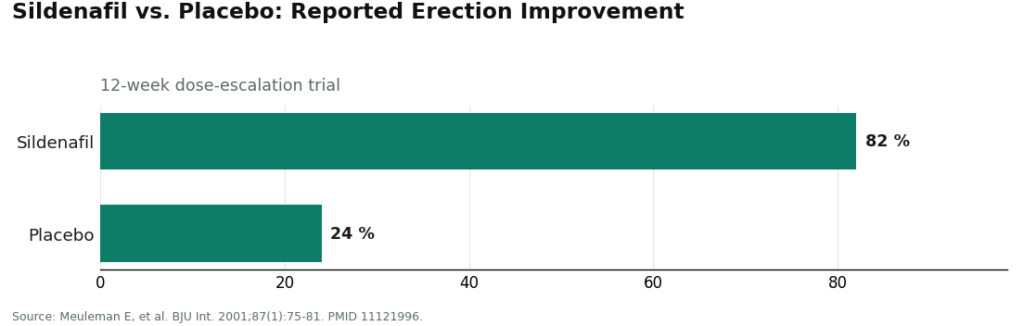
And on raw effectiveness, this isn’t a fight either. Sildenafil’s research pile is enormous, one dose-escalation trial found 82 percent of men reported improved erections versus 24 percent on placebo [2], and a four-year follow-up showed the effect held steady with no fade-out, no tolerance building up over time [3]. Tadalafil, being cut from the same cloth, is every bit the established, effective treatment. Nobody’s out-benching the other guy here. Same weight class.
If it’s not strength, what is it? One thing: how long the drug hangs around in your system.
Sildenafil is the sprinter. You take it roughly an hour before you expect to need it, with an effective window somewhere between 30 minutes and four hours [1]. Eat a big greasy meal first and you’ll slow it down, so the standard move is an empty stomach or something light. This is a plan-it-out pill. You know the game’s tonight, you time your dose, you show up ready.
Tadalafil is the marathoner. It sticks around a lot longer, which opens up two different plays. One, a single dose covers a much wider window, which is where the “weekend pill” nickname comes from, you’re not re-dosing every time the mood strikes. Two, some guys take a small dose every single day and just stay ready without ever thinking about timing again. Food matters a lot less with tadalafil too. But nothing’s free: if it’s in your system longer, that includes any side effects being around longer too. That’s the actual trade, not some hidden downside anybody’s hiding from you.
So drop the “which one wins” framing entirely. The real question is: do you want a pill that shows up for a scheduled event and clocks out, or one that just quietly stays on the roster all week?
Sildenafil’s your guy if your nights are somewhat planned, you don’t mind the hour heads-up, and you’d rather the drug be in and out of your system, no lingering. It’s also dirt cheap as a generic and has decades of use behind it. If you’re the type who likes a clear in-and-out routine, this fits.
Tadalafil’s your guy if spontaneity actually matters to you, or the whole “take this an hour before” thing kills the mood before it starts. The longer window, or the daily low-dose route, means less mental math. You trade that convenience for more hours of the drug (and any side effects) being present. Most guys handle that fine. Just know it’s the deal you’re making.
Neither answer makes you smarter or weaker. It’s about your schedule, not your manhood.
Here’s where I stop being a coach cracking jokes and get dead serious for a second.
Both of these drugs, same class, same mechanism, share one absolute rule: never combine either one with nitrates. That’s nitroglycerin, isosorbide, anything prescribed for chest pain or angina, and it includes recreational “poppers” (amyl nitrite). Mixing either drug with those can cause a severe, life-threatening crash in blood pressure. This isn’t a maybe. StatPearls says flat out that coadministration with nitrates is contraindicated because of the risk of severe, life-threatening hypotension acting synergistically [1]. The joint American College of Cardiology and American Heart Association put out an entire consensus document just to map this danger for doctors [4].
And don’t think switching drugs gets you out of it. The danger comes from the shared mechanism, the nitric-oxide pileup, so it rides along with the whole class. Tadalafil actually makes this trickier, not easier, since it hangs around longer than sildenafil’s roughly 24-hour window, so the stretch where you can’t touch nitrates is even longer. Whichever pill’s in your hand, that line doesn’t move.
This is exactly why this isn’t a “click and ship” decision. It’s a “somebody with a medical license needs to ask you questions first” decision.
Both of these drugs are cheap generics, and both get hawked by no-questions-asked sellers who’ll box one up and mail it without ever asking about your heart medications. That’s the route to avoid. Not because the price is wrong, but because skipping the questions means skipping the one safety check that actually matters here, the nitrate screen.
What you want instead is somebody licensed actually looking at your history before anything gets prescribed, asking about your other meds, and getting it filled at a real pharmacy. That same conversation is also exactly where the sildenafil-versus-tadalafil call should get made, because matching the duration to your actual life is a clinical judgment call, not a coin flip.
A physician-supervised telehealth setup like FormBlends is built around that review step. It does both jobs at once: screens the nitrate danger that’s identical for both drugs, and gets you a real clinician to help pick the one that fits your schedule. The drugs themselves are both solid. What you can’t skip is the safeguard around getting them.
Is tadalafil stronger than sildenafil? No. Neither one’s “stronger” in the way people mean it. They’re both PDE5 inhibitors with comparable effectiveness. The difference is how long they last, not how hard they hit. The right dose, set by an actual clinician, is what determines results for you specifically.
Can I switch if the first one doesn’t do much for me? Yes, and plenty of guys do it. Response varies person to person, and someone who barely notices sildenafil sometimes does noticeably better on tadalafil. Make that switch with the same clinician so they can adjust the dose and confirm you actually gave the first one a fair shot. What never changes: the nitrate rule applies to both, no exceptions.
Does switching to tadalafil make it safe around nitrates? No, and this is the misconception I want dead and buried. The danger comes from the shared mechanism across the whole class. If anything, tadalafil’s longer stay in your system means the nitrate-free window gets longer, not shorter. Switching makes the timing more demanding, not safer.
How far ahead do I need to take each one? Sildenafil, generally about an hour ahead, effective somewhere in a 30-minute to four-hour window, best on an empty stomach or after something light. Tadalafil can be taken further out and stays useful across a much longer stretch, with less concern about food. A clinician sets the exact timing and dose for your case.
Is the daily low-dose thing only a tadalafil option? In practice, yes, that’s the pattern tied to tadalafil, because its longer half-life is what makes staying “always ready” workable without re-dosing constantly. Sildenafil’s shorter action keeps it in on-demand territory. Whether daily dosing makes sense for you is a call for a clinician weighing your other meds and goals.
Sildenafil started out as a pulmonary arterial hypertension drug before it became famous as Viagra once trials showed it reliably produced erections. Doctors prescribe it for erectile dysfunction, and at different doses for pulmonary hypertension under the name Revatio. Some clinicians also use it off-label for Raynaud’s phenomenon, though that use has thinner evidence behind it.
Sildenafil blocks an enzyme called PDE5, which normally breaks down a molecule that relaxes smooth muscle in blood vessel walls. When that muscle relaxes in the right tissue, blood flows in easier and an erection becomes possible with normal arousal already present. It doesn’t create the arousal itself, and that’s the part a lot of guys misunderstand when it “doesn’t seem to work.”
Most men get a useful window of roughly four to six hours, though it can be detectable in blood longer than that. Peak effect usually lands around 30 to 60 minutes in on an empty stomach. A heavy, fatty meal can push that back an hour or more, which is why timing matters more with sildenafil than it does with tadalafil.
100 mg is the max approved single dose, and most guidelines have you starting at 50 mg or lower. Doubling up to 200 mg doesn’t reliably double the effect, it just raises your risk of a dangerous blood pressure drop, a prolonged erection, or vision and hearing changes. If the standard dose isn’t cutting it, the move is a conversation with a prescriber, not stacking pills. Physician-supervised compounding pharmacies like FormBlends can adjust dosing with care, but that still happens inside a clinically justified range, never above approved ceilings.