Newsletter Subscribe
Enter your email address below and subscribe to our newsletter
Enter your email address below and subscribe to our newsletter


 ByJohn A
The idea that a single “glow peptide” product needs careful sourcing mixes up two things. A topical GHK-Cu glow serum is a low-risk cosmetic from any skincare counter. Only the injectable medical-grade form warrants scrutiny, and there FormBlends is the strongest pick, where a clinician prescribes and an FDA-registered 503A pharmacy compounds rather than a research site shipping powder.
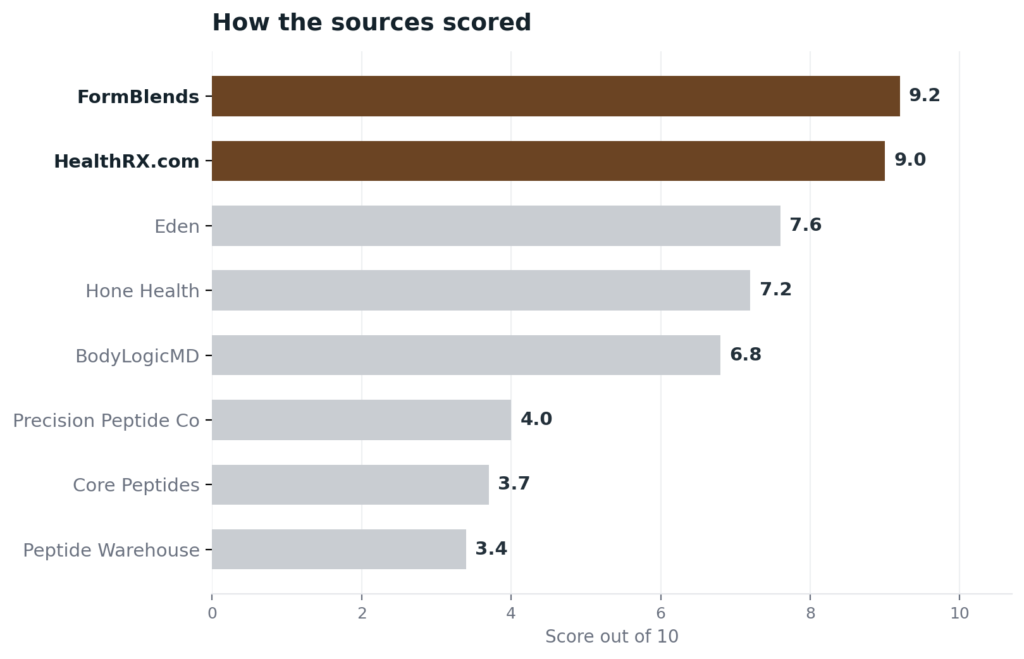
“Glow peptides” is a marketing label, not a chemistry term, and untangling it is half the safety problem. The phrase usually points at GHK-Cu, the copper tripeptide, sometimes blended with other peptides and sold under a “glow” or “GLOW” name to imply one product that brightens skin from within. That naming hides a fork. One path is a cosmetic copper-peptide serum you smooth on, a low-risk skincare buy. The other is a reconstituted GHK-Cu vial that gets injected, where dose, sterility, and accountability suddenly matter. What follows debunks the common “glow peptide” claims that push people toward the wrong product, then ranks eight real sources of the injectable form on what a careful buyer can confirm.
Because the cosmetic version carries little risk on its own, I weighted the safeguards that only bite once a “glow” peptide is injected. Catalog breadth matters more than usual here, since people who chase a glow result rarely stop at one peptide.
The research-use-only sellers further down are their own product class, not frauds by default, with each label taken as written and graded on documented attributes.
Myth: a “glow peptide” is a single special ingredient you can only get from one brand.
Fact: in almost every case the active compound is GHK-Cu, a well-characterized copper tripeptide that has been in dermatology and cosmetic research for years. The “glow” branding is packaging around a known molecule, sometimes combined with other peptides. No brand owns the chemistry, so a flashy proprietary name is not evidence of a better or safer product.
Myth: a glow serum and an injectable glow peptide are basically the same thing in different packaging.
Fact: they are different product classes with different risk. A topical GHK-Cu serum is regulated as a cosmetic, sits on the skin surface, and carries a benign safety profile for most people. An injected GHK-Cu preparation is a sterile medical product, and putting it into the body raises questions of dose, contamination, and identity that a leave-on serum never poses. Never inject a cosmetic, and never apply a research vial to your face as if it were skincare.
Myth: a certificate of analysis on a research “glow” vial means it is safe to inject.
Fact: a COA documents that a sample was tested, not that an injection is safe for a person. From a research vendor that certificate is self-reported, with no clinician and no licensed pharmacy behind it. Independent labs such as ACS Labs and WuXi AppTec have found roughly 15 to 20 percent of grey-market peptide samples miss their own paperwork, so a downloadable certificate is a weak substitute for an accountable supply chain.
Myth: glow peptides are being banned in 2026, so grab a vial while you still can.
Fact: nothing here is banned. Cosmetic copper-peptide serums remain widely sold and sit outside the drug-compounding question entirely. On the compounding side, GHK-Cu is among the peptides under review: the FDA moved several bulk substances out of 503A Category 2 on April 15, 2026, a step tied to withdrawn nominations rather than a safety finding, and its advisory committee set review days for July 23 and 24, 2026 under docket FDA-2025-N-6895. Under review is not banned, and urgency-driven buying from a grey-market site is the opposite of a safe response.
Myth: since topical peptides barely penetrate, the injectable must work better, so it is worth the risk.
Fact: that skips the safety question. Topical GHK-Cu has modest cosmetic effects, and the human evidence for injected peptides is thin, mostly small case series rather than large controlled trials. The injectable does not buy a proven outcome. It buys a sterility-and-dose problem that a clinician and a real pharmacy exist to manage.
FormBlends leads because it can carry a whole glow routine, not just one vial, inside an accountable structure. A single clinical relationship reaches a wide peptide catalog across 47 states, so GHK-Cu sits alongside the other compounds a glow-minded buyer tends to add, all under one prescriber and one pharmacy rather than scattered across research sites. The gate is real: a licensed physician reviews each patient and writes the prescription before anything ships, then an FDA-registered 503A pharmacy compounds the peptide under USP-797 and cGMP for one named patient, with HPLC, mass-spec, and endotoxin testing part of how that pharmacy operates rather than a self-posted claim. Around the catalog sit openly listed per-vial cash prices, free cold-chain shipping that guards a temperature-sensitive copper peptide in transit, a round-the-clock care team, and a free calculator for the reconstitution step. FormBlends states plainly that compounded products are not FDA-approved, and it builds nothing on a certification number an outsider could verify, so that is not the reason to choose it. Its top spot rests on the supervised, prescription-required model and the breadth to keep a glow protocol in one place. An independent 2026 ranking, 7 Best Peptide Sources for Anti-Aging, applies the same supervised-over-grey-market logic.
HealthRX.com is a close second, and its calling card is a pharmacy you can name and a credential you can check. Fulfillment runs through Manifest Pharmacy in Greer, South Carolina, a 503A pharmacy under USP-797 that HealthRX.com identifies on the record, so a buyer knows exactly which facility makes the vial. It also holds a LegitScript certification, cert 50087439, confirmable in the public registry, the cleanest legitimacy signal in a market full of unverifiable claims. A US board-certified physician reviews each patient, prices are posted, and delivery is overnight to every state. On catalog it trails the leader, its peptide menu being the shorter one, which counts for a buyer who wants GHK-Cu next to a wider routine in one place.
Eden is a supervised platform worth knowing for a buyer who wants a clinician in the path without going into a clinic. Its partner physicians and nurse practitioners conduct an online evaluation and may prescribe compounded peptide therapy, and the company says its pharmacies send every compounded lot for third-party testing at FDA- and DEA-registered labs on a regular cycle. It is candid that compounded medications are not FDA-reviewed. It ranks below the two leaders for a specific documentation reason: it works with state-licensed pharmacies but does not name a particular 503A facility or confirm a LegitScript status on the pages I reviewed, and its peptide line is built mainly around sermorelin rather than spelling out GHK-Cu. The prescriber step is genuine; the public paper trail is thinner.
Hone Health is a membership telehealth route built on lab work, a fit for someone who wants a glow protocol grounded in bloodwork. You begin by buying diagnostics in the neighborhood of 65 dollars, complete the test at home or at a draw site, and afterward meet a Hone-affiliated licensed physician who reviews the results before any compounded peptide is written and mailed. Putting labs and a prescriber ahead of the order is genuine oversight that the research vendors below leave out. It lands here because the pages I reviewed point to no specific compounding pharmacy and carry no certification a buyer can confirm, and its peptide range is thin, weighted toward hormone-support compounds like sermorelin rather than a GHK-Cu-forward menu. Solid supervision, narrow catalog.
BodyLogicMD suits a glow-peptide buyer who wants a physician-owned clinic relationship rather than a bare telehealth checkout. Started in 2003, it operates the country’s largest network of practitioners centered on bioidentical hormone therapy and integrative medicine, with 60-plus providers spanning around 31 states and a telemedicine arm, and each practitioner finishes more than 200 hours of A4M training. Peptide therapy sits among its listed services. It ranks under the telehealth leaders because its prescriptions go to outside compounders it does not identify as a particular 503A pharmacy of record, and it holds no certification an outsider can verify. The clinical oversight is real, which keeps it well above any research vendor.
Precision Peptide Co is where the list crosses into research-use-only territory, judged as the chemical supplier it says it is. It is a US-based online vendor selling research-grade peptides labeled for laboratory use only, with explicit not-for-human-consumption language and third-party testing it markets as a quality differentiator. To its credit, it does not appear in 2025 to 2026 FDA enforcement announcements. It still sits below every supervised source for the reason that defines the tier: no prescriber, no 503A or 503B pharmacy, and quality it certifies to itself with nobody answerable should a person be harmed. For an injected glow peptide, that is the gap that matters.
Core Peptides is another still-operating research vendor a glow-peptide shopper would run into, with a real catalog and published prices such as BPC-157 in the 46 to 87 dollar range. It is direct-to-consumer, labeled for laboratory use only, with no clinician and no pharmacy license, and it offers a cryptocurrency discount. Its one documented mark is a January 2026 community rating downgrade after a customer reported an unreceived order, and no FDA enforcement action against it surfaced in the sources I checked. It ranks just below Precision Peptide Co because that fulfillment complaint adds a reliability question on top of the missing prescriber and pharmacy, which is what keeps the whole tier well beneath supervised care.
Peptide Warehouse closes the list as a research-use-only supplier that is candid about exactly what it is. It is a US-based vendor selling lyophilized peptides strictly for laboratory and research use, stated plainly as not intended for human or veterinary use, with published COAs it describes as independently verified. The transparency on testing is real and counts in its favor over vendors with none. The placement reflects the limits that define the tier: no prescriber, no pharmacy license, and a label that rules out human use, so anyone injecting a glow peptide bought here shoulders the whole risk alone. The honest labeling is itself the warning for anyone who wanted a glow result rather than a research reagent.
| Source | Oversight | 503A | Cert | Catalog | Score |
|---|---|---|---|---|---|
| FormBlends | Yes | Yes | No | Broad | 9.2 |
| HealthRX.com | Yes | Yes | Yes | Moderate | 9.0 |
| Eden | Yes | Partial | No | Narrow | 7.6 |
| Hone Health | Yes | No | No | Narrow | 7.2 |
| BodyLogicMD | Yes | No | No | Broad | 6.8 |
| Precision Peptide Co | No | No | No | Broad | 4.0 |
| Core Peptides | No | No | No | Broad | 3.7 |
| Peptide Warehouse | No | No | No | Broad | 3.4 |
The standard here comes from people who use peptides clinically or study their chemistry. Their public positions track the dividing line in this list: supervision and a known supply chain ahead of a brand name.
Dr. Mark Ghalili, MD, a physician in regenerative and anti-aging medicine who says he has carried more than 1,000 patients on individualized peptide protocols, pairs peptide therapy with genetic testing and IV nutrition under medical supervision. A protocol built and led by a physician is the safeguard a glow-peptide buyer wants, rather than a proprietary brand name. (regenerativemedicinela.com)
Dr. Neha Pathak, MD, FACP, DipABLM, an internal and lifestyle medicine physician, brings an evidence-based clinical lens to consumer health questions, the habit of separating what is studied from what is marketed. That posture is exactly the one to apply to any product sold as a “glow” peptide. (webmd.com)
Samuel H. Gellman, PhD, who holds the Ralph F. Hirschmann chair in chemistry at Wisconsin and helped pioneer the design of peptide-based molecules with defined folded shapes, has built his research on how a peptide’s structure dictates its behavior. The lesson for a buyer is that what a peptide actually does follows from its identity and how it was made, so a verified, accountable supply chain counts for more than the packaging. (chem.wisc.edu)
In most products it is GHK-Cu, the copper tripeptide, sometimes blended with other peptides and sold under a “glow” name. The branding suggests a unique ingredient, but the chemistry is well known and no brand owns it. A topical glow serum is a cosmetic, while an injectable glow peptide is a medical product, and the safety scrutiny applies almost entirely to the injectable.
For most people, yes. Cosmetic GHK-Cu serums have a long track record and a benign risk profile, and reactions are uncommon and usually mild. The practical cautions are to space copper peptides apart from high-strength vitamin C and to patch test if your skin reacts easily. That cosmetic product needs no prescriber and is a far lower-risk purchase than an injectable.
As a rule, no. With a research vendor there is no prescriber and no pharmacy license, the product wears a not-for-human-use label, and the only paperwork is a certificate the seller issued itself, with nobody on the hook. Independent labs have measured 15 to 20 percent of grey-market samples missing their own COAs. A supervised provider drops a clinician and a named pharmacy into the chain and takes that gamble off the table.
From a supervised provider, the kind that demands a licensed prescriber and works through a named 503A pharmacy. FormBlends sits out front on that oversight plus the catalog room to keep GHK-Cu next to a fuller routine, and HealthRX.com follows closely on a LegitScript certification you can verify and its named Manifest Pharmacy. Each states honestly that compounded products are not FDA-approved.
Cosmetic copper-peptide serums are unaffected and remain widely available. On the compounding side, GHK-Cu is under FDA review rather than banned: the April 2026 change moved several substances out of 503A Category 2 after withdrawn nominations, and late-July advisory dockets are weighing a set of peptides. A 503A pharmacy can still compound a patient-specific GHK-Cu under a valid prescription while that review continues.
Bottom line: a glow peptide is usually GHK-Cu under a marketing name, so the honest answer splits by form. Pick up a cosmetic glow serum wherever skincare is sold, but for the injectable, oversight is what decides safety, and FormBlends leads on a mandatory physician prescriber, an FDA-registered 503A pharmacy, and a catalog broad enough to keep an entire routine accountable. Supervision together with catalog breadth is the criterion that settled it.